
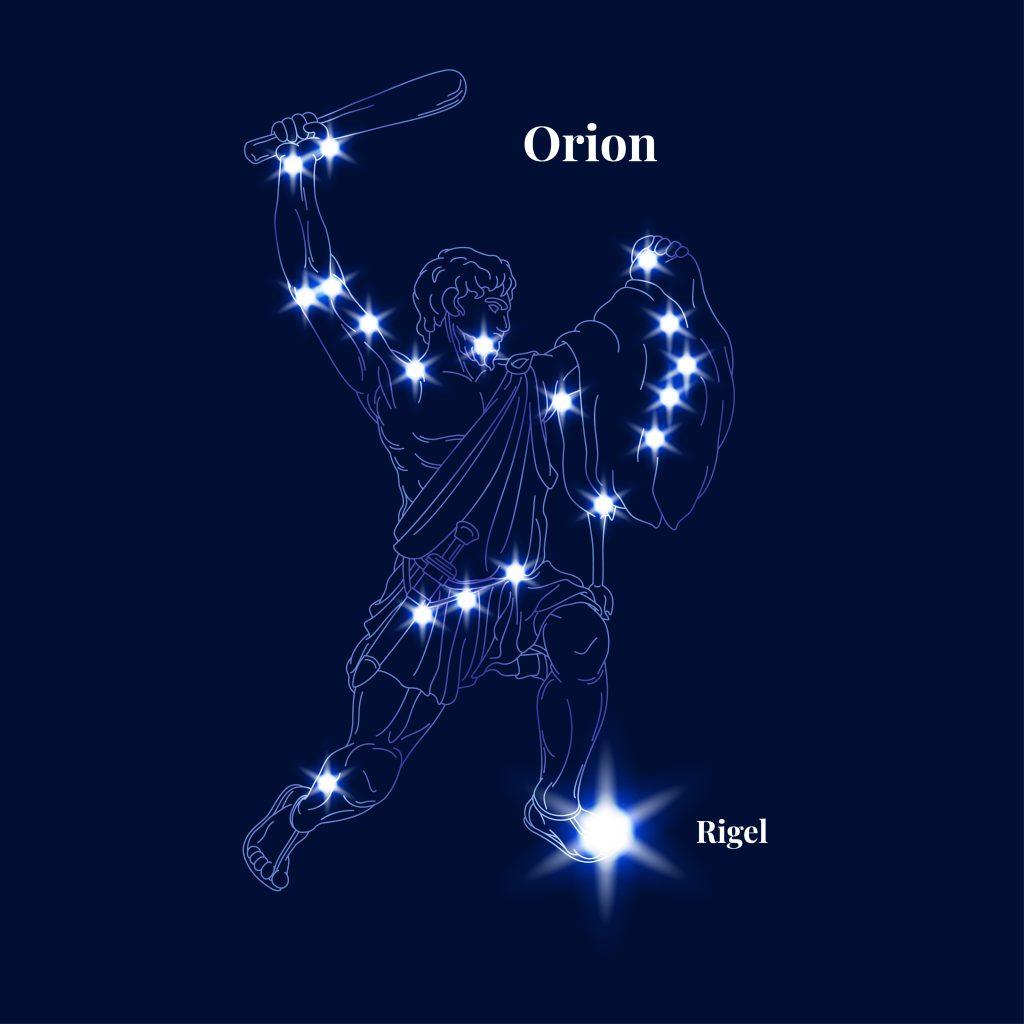
The Hunter of the Cosmos
Table of Contents
The constellation Orion is one of the most recognisable and celebrated groupings of stars in the night sky. Often associated with mythology and ancient lore, Orion has captured the imagination of cultures worldwide. From its striking appearance in the winter sky to its deep astronomical significance, this constellation serves as a focal point for both amateur and professional astronomers. In this article, we will delve into the origin of its name, explore its rich mythology, trace its historical significance, examine its notable stars and deep sky objects, discuss the existence of exoplanets within its bounds, and highlight its importance in modern science.
Origin of Name
The name “Orion” is derived from Greek mythology, specifically referring to a giant huntsman. The etymology of the name itself is somewhat ambiguous. Some scholars suggest that it may originate from the Greek word “orios” meaning “boundary” or “limit,” which would connect to the concept of a hunter wandering outside the boundaries of civilized society. Another possibility ties the name to an ancient Greek word for “to rise” or “to be visible,” alluding to its prominence in the night sky. Regardless of its exact roots, the name “Orion” has been embedded in cultural and scientific contexts for millennia, solidifying its identity as a celestial hunter.
Mythology
Western Mythology
In Western mythology, Orion is often depicted as a mighty hunter. According to Greek legends, he was the son of Poseidon, the god of the sea, and Euryale, a Gorgon. Orion was gifted with extraordinary strength and beauty. However, his hubris became his downfall. In one popular myth, he boasted that he could hunt and kill all the beasts on Earth, which enraged Gaia, the Earth goddess. As a consequence, Gaia sent a scorpion to defeat him. This led to the idea that Orion and Scorpius, the scorpion, could never be seen in the sky at the same time.
The myth of Orion also connects to other constellations, such as Ophiuchus, the Serpent Bearer, who was said to have revived Orion after he was fatally stung. This narrative interweaves the constellations into a larger cosmic drama that has fascinated observers for generations.
Eastern Mythology
Orion’s presence is not limited to Western cultures. In ancient Babylon, he was known as MULSIPA.ZI.AN.NA, meaning “The Heavenly Shepherd.” This designation emphasized his role in agriculture and celestial navigation. In Chinese astronomy, the three stars of Orion’s Belt are known as “Shen,” meaning “three,” and were part of the 28 lunar mansions used in Chinese astrology. In Hindu mythology, Orion is often associated with Rudra, a form of Shiva, who is linked to the star Betelgeuse. Across various cultures, Orion embodies traits of strength, guidance, and protection.

History
The constellation Orion has a long-standing history in astronomy. It was catalogued by the ancient Greek astronomer Ptolemy in the 2nd century. However, the recognition of this constellation predates Ptolemy, with evidence of its identification found in prehistoric cave art and ancient star charts. Orion’s visibility during winter months in the Northern Hemisphere made it an essential marker for navigation and timekeeping for many ancient civilizations.
Orion’s significance extended beyond practical astronomy. The constellation is frequently mentioned in classical literature, including works by Homer and Virgil. It also played a role in calendar systems, serving as a celestial marker for agricultural cycles in various cultures.

Notable Stars
Orion hosts several remarkable stars, each with its own unique characteristics. Here’s a list of some of the most notable stars within this constellation:
Betelgeuse (Alpha Orionis)
Betelgeuse is a red supergiant star located approximately 700 light-years from Earth. As one of the brightest stars in the night sky, it stands out with its distinctive reddish hue. Betelgeuse is about 1,000 times larger than our Sun, making it one of the largest stars known. Its immense size is accompanied by a vast volume, meaning if it were placed at the centre of our solar system, it would extend past the orbit of Mars. This star is nearing the end of its lifecycle and is expected to explode as a supernova within the next 100,000 years. The name Betelgeuse originates from the Arabic phrase “Yad al-Jauza,” which translates to “the hand of the giant,” highlighting its prominence in both astronomy and history.
Rigel (Beta Orionis)
Rigel is a brilliant blue supergiant star situated approximately 860 light-years away from Earth. It is the seventh-brightest star in the night sky and emits an astonishing brightness, around 120,000 times greater than that of the Sun. Rigel’s striking blue colour is a result of its high surface temperature, estimated to be around 11,000 Kelvin. It marks the foot of the Orion constellation and serves as an important navigational star, often used by sailors and astronomers. Rigel is significantly larger than our Sun, with a radius roughly 78 times greater, and plays a crucial role in the mythology and astronomy of various cultures.
Bellatrix (Gamma Orionis)
Bellatrix, known as the “female warrior,” is a blue giant star located about 244 light-years from Earth. As the third-brightest star in Orion, it has a luminosity approximately 10,000 times greater than that of the Sun. Bellatrix is classified as a B-type star, characterized by its rapid rotation and high temperature, which is around 22,000 Kelvin. This rapid spinning contributes to its unique atmospheric properties, creating strong stellar winds. Positioned at the shoulder of Orion, Bellatrix is often overshadowed by its brighter neighbours but is nonetheless significant in the constellation’s structure. Its name reflects its role in various mythologies, where it is associated with strength and valour.
Saiph (Kappa Orionis)
Saiph is a prominent blue supergiant star located approximately 720 light-years from Earth. It is often recognized for its striking colour and represents the other knee of the Orion figure. Saiph shines with a luminosity roughly 25,000 times that of the Sun, making it one of the brightest stars in the constellation. Its surface temperature is estimated to be around 20,000 Kelvin, giving it a vivid blue appearance. Saiph is less well-known than Betelgeuse and Rigel but plays an essential role in the shape of Orion. The name “Saiph” comes from the Arabic term for “sword,” further connecting it to the themes of battle and valour prevalent in many star names.
Meissa (Lambda Orionis)
Meissa, also known as Lambda Orionis, is a double star system located approximately 1,100 light-years away from Earth. It forms the head of the Orion constellation and is less bright than the other notable stars in Orion, but it still holds significance due to its position. The system consists of a primary blue giant star and a secondary smaller companion star, which can be distinguished through telescopes. Meissa has a luminosity about 1,500 times that of the Sun, and its surface temperature is around 40,000 Kelvin, which contributes to its blue-white coloration. The name Meissa is derived from the Arabic word meaning “the shining one,” reflecting its role as a guiding star in the constellation.
Orion’s Belt (Alnitak, Alnilam, Mintaka)
While not individual stars, Orion’s Belt consists of three prominent stars: Alnitak, Alnilam, and Mintaka, which form a straight line in the night sky. Alnitak, located approximately 800 light-years away, is a hot, massive O-type star with a brightness around 100,000 times that of the Sun. Alnilam, the central star of the trio, is about 1,000 light-years away and is also a supergiant, shining with a luminosity 375,000 times that of the Sun. Mintaka, the westernmost star, is approximately 1,200 light-years from Earth and is notable for being a binary star system. Together, these stars not only define Orion’s Belt but also serve as an important navigational feature and a point of cultural significance across various civilizations. Their arrangement in the sky has inspired myths and stories throughout history.
Notable Deep Sky Objects
Orion is not only home to bright stars but also features a wealth of intriguing deep-sky objects. Some notable examples include:
Orion Nebula (M42)
Located in Orion’s Sword, the Orion Nebula is one of the brightest nebulae visible to the naked eye. It is a stellar nursery where new stars are born, making it a favourite among astronomers and astrophotographers.

Barnard’s Loop
A large, faint loop of gas that encircles the Orion Nebula, Barnard’s Loop is part of the Orion Molecular Cloud Complex and provides a beautiful background for observations.
Horsehead Nebula (IC 434)
Named for its distinctive shape, the Horsehead Nebula is located near the star Alnitak and is one of the most photographed nebulae in the night sky.
M78 (NGC 2068)
This reflection nebula is associated with the molecular cloud complex in Orion and is notable for its distinct brightness compared to surrounding areas.

Running Man Nebula
Located adjacent to the Orion Nebula, this nebula gets its name from its appearance, resembling a figure in motion.
NGC 1999
Another reflection nebula, NGC 1999 features a notable variable star, V380 Orionis, embedded within it.
These deep-sky objects not only captivate the imagination but also provide essential insights into star formation and the dynamics of our galaxy.
Location and Visibility
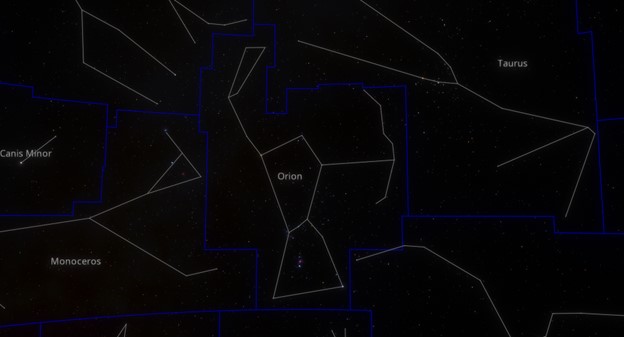
Orion is best observed during the winter months, especially from December to March, when it dominates the night sky. This iconic constellation, known as the “Hunter,” is easily identifiable and visible from almost every inhabited region of the Earth. The visibility of Orion’s bright stars, such as Betelgeuse and Rigel, makes it a favourite among stargazers. For the best experience, seek areas with minimal light pollution to appreciate its rich star fields and deep-sky objects, such as the Orion Nebula (M42), which can be viewed in detail with binoculars or a small telescope.
Summary
• When to observe: Best from December to March.
• Where to observe: Visible worldwide, especially prominent in the Northern Hemisphere.
• How to observe: Look for dark skies to enhance visibility; binoculars or telescopes can help observe its deep-sky features.
Exoplanets
In recent years, astronomers have discovered exoplanets in the vicinity of the constellation Orion. Notable among these is the exoplanet HD 39853 b, located approximately 70 light-years away from Earth. This gas giant orbits a G-type star and is notable for being situated in a star system that has generated interest for its potential to host additional planets.
Furthermore, research is ongoing, and the prospects of finding additional exoplanets in Orion remain promising as observational technologies advance.
Importance in Modern Science
The constellation Orion holds a significant place in modern astronomy and serves as a focal point for various scientific studies. Its prominence in the night sky has made it a natural laboratory for astronomers seeking to understand stellar evolution, cosmic formation, and the fundamental processes of our universe.
The Orion Nebula, for instance, is a key site for studying the birth and development of stars. As one of the nearest regions of active star formation, it allows astronomers to observe the processes involved in stellar birth and the dynamics of interstellar matter. Studies of the Orion Molecular Cloud Complex have provided valuable insights into the conditions necessary for star formation and the evolution of galaxies.
Additionally, the stars of Orion, particularly Betelgeuse, are subjects of ongoing research to understand stellar life cycles. Observations of these stars contribute to our knowledge of supernova mechanics, stellar winds, and the fate of massive stars.
Furthermore, Orion serves as a reference point for navigating the night sky and is frequently used in astrobiology discussions, especially in the context of exoplanet searches. Its combination of bright stars and rich deep-sky objects provides a vast canvas for both observational and theoretical research.
